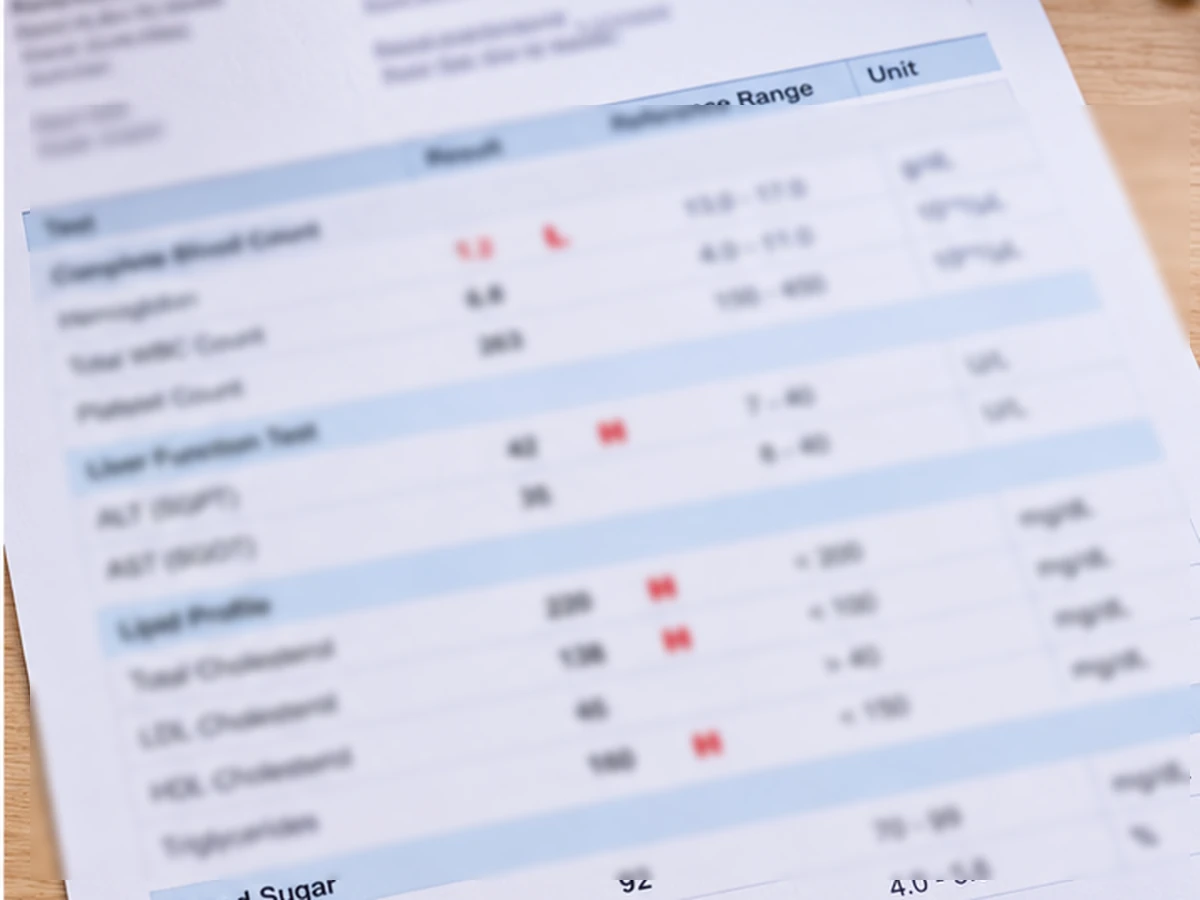
This guide explains the layout of a typical report and the short forms you'll see, using our own Alpha Laboratory reports from Banur as the example. It's for understanding, not diagnosis. Your doctor reads the result alongside your symptoms, history and other tests, and that's the reading that counts. If a line on your report doesn't make sense, call us on 8872524007 and we'll explain what it measures.
Parts of a report
Most pathology reports in India follow the same pattern, so once you know how to check a blood test report from one lab, others look familiar.
Header. Patient name, age, sex, a patient or lab ID, the referring doctor, and dates. Check your name and age first. Reference ranges depend on age and sex, so an error here matters.
Sample details. When the sample was collected and when it was reported, and the sample type (whole blood, serum, plasma, urine). For sugar tests, the collection time tells your doctor whether it was a fasting or post-meal sample.
Test name and method. For example "Haemoglobin, photometric" or "TSH, CLIA". The method matters because different methods can give slightly different numbers.
Result. Your value, usually in bold if it's flagged.
Unit. g/dL, mg/dL, cells/cumm, %, ng/mL, mIU/L. Always read the number with its unit. A haemoglobin of 12 means something; a "12" with no unit means nothing.
Reference range (sometimes "biological reference interval" or "normal value"). The range most healthy people fall within at that lab.
Signature. At the end, the reporting pathologist signs or authorises the report. Some reports also carry interpretive comments, for example for HbA1c or lipid profile.
Reference ranges and why they differ
A reference range is usually built so that about 95 out of 100 healthy people fall inside it. That means a few healthy people will always fall just outside, simply by chance. A result slightly out of range on one test is common and often not significant on its own.
Ranges also differ between labs, for good reasons:
- Method and machine. Two analysers can measure the same substance slightly differently, so each lab sets or verifies its own range.
- Age and sex. Haemoglobin is normally higher in men than in women. Alkaline phosphatase is much higher in growing children. ESR rises with age.
- Pregnancy. Haemoglobin, thyroid hormones and several other values have pregnancy-specific ranges.
- Units. Some labs report glucose in mmol/L instead of mg/dL. Indian labs mostly use mg/dL.
So the range printed on your report is the one that applies to your result. If you compare reports from two labs, compare each result to its own range, not to each other.
Some tests use decision limits instead of a "normal" range. HbA1c is a good example. The American Diabetes Association uses below 5.7% as normal, 5.7% to 6.4% as prediabetes and 6.5% or above as diabetes. Fasting glucose uses 100 and 126 mg/dL in the same way. Your doctor decides what applies to you, often after a repeat test.
High and low flags
H or ↑ means above the range; L or ↓ means below. Some labs also mark critical values, which are results far enough outside the range that the lab calls the doctor or patient straight away.
A few things to keep in mind when reading flags:
- Size matters. A potassium of 5.2 mmol/L on a range ending at 5.1 is very different from 6.5.
- Patterns matter more than one line. A low haemoglobin with a low MCV and MCH points in a different direction from a low haemoglobin with a high MCV. Your doctor reads them together.
- Preparation affects results. Eating before a fasting test, a hard workout, dehydration or biotin supplements can all shift numbers.
- Trends beat snapshots. Bring your old reports. A creatinine that has crept up over three years tells more than a single value.
Don't start, stop or change any medicine because of a flag. Take the report to your doctor.
Common abbreviations (Hb, TLC, DLC, MCV, MCH, MCHC, RDW, ESR)
Most of these come from the CBC (complete blood count), the commonest test on any lab slip. Ranges below are typical adult values, given only as a guide; the range printed on your report is the one that applies, since ranges vary by lab and method.
| Short form | What it means | Typical adult range |
|---|---|---|
| Hb | Haemoglobin, the oxygen-carrying protein in red cells | About 13–17 g/dL (men), 12–15.5 g/dL (women) |
| TLC (or TC, WBC) | Total leucocyte count, all white blood cells | About 4,000–11,000 cells/cumm |
| DLC | Differential leucocyte count, the share of each white cell type | Neutrophils 40–75%, lymphocytes 20–45%, eosinophils 1–6%, monocytes 2–10%, basophils 0–1% |
| RBC | Red blood cell count | About 4.5–5.5 million/cumm (men), 3.8–4.8 (women) |
| PCV / HCT | Packed cell volume, the share of blood made up of red cells | About 40–50% (men), 36–46% (women) |
| MCV | Mean corpuscular volume, the average size of a red cell | About 80–100 fL |
| MCH | Mean corpuscular haemoglobin, average haemoglobin per red cell | About 27–32 pg |
| MCHC | Mean corpuscular haemoglobin concentration | About 32–36 g/dL |
| RDW | Red cell distribution width, how much red cells vary in size | About 11.5–14.5% |
| PLT | Platelet count | About 1.5–4.5 lakh/cumm |
| ESR | Erythrocyte sedimentation rate, how fast red cells settle in an hour | Up to about 15 mm/hr (men), 20 mm/hr (women); higher with age |
The ESR test is not specific to any one disease. It goes up with infection, inflammation, anaemia and pregnancy, and doctors use it mostly to track a condition over time.
You'll also see abbreviations from other common panels:
- LFT (liver function test): SGOT (AST), SGPT (ALT), ALP, GGT, bilirubin (total, direct, indirect), total protein, albumin, globulin, A/G ratio.
- KFT (kidney function test): urea, BUN, creatinine, uric acid, sodium (Na), potassium (K), chloride (Cl). Some reports add eGFR, an estimate of kidney filtering worked out from creatinine, age and sex.
- Lipid profile: TC or total cholesterol, TG (triglycerides), HDL, LDL, VLDL, and ratios like TC/HDL.
For any other test name on your slip, search our full list of tests; each page explains what the test checks.
When to see your doctor
Always, really. Even a report with no flags should go back to the doctor who ordered it, because they asked for it with a question in mind.
Go sooner, or call your doctor the same day, if the lab has phoned you about a critical value, or if the report shows very high sugar, very low haemoglobin, a very low platelet count during fever, or high potassium. Those calls are rare, but they're why we ask for a working phone number.
If you have chest pain, breathlessness, confusion, fainting, bleeding or severe dengue warning signs such as persistent vomiting or severe stomach pain, don't wait for a report. Go to the nearest emergency department.
When you visit the doctor, take this report and your older ones, plus a list of your medicines. If you want a repeat test or a test your doctor has added, you can book it with us here.
FAQ
What is MCH in a blood test?
MCH stands for mean corpuscular haemoglobin, the average amount of haemoglobin inside one red blood cell, measured in picograms (pg). A low MCH often goes with small, pale red cells, as in iron deficiency; a high MCH often goes with large cells. Your doctor interprets it with Hb, MCV and MCHC.
What is DLC in a blood test?
DLC is the differential leucocyte count. It splits your white blood cells into five types (neutrophils, lymphocytes, monocytes, eosinophils and basophils) and gives each as a percentage. Different infections and allergies shift the balance in different ways.
What is TC in a blood test?
It depends on the panel. In a CBC, TC usually means total count, the same as TLC, the total number of white blood cells. In a lipid profile, TC means total cholesterol. Look at the section heading and the unit to tell them apart.
How to read the results of a blood test from a different lab?
Compare each result with the reference range printed on that lab's own report. Don't compare raw numbers across two labs, as methods and ranges differ.
My result is just outside the range. Should I worry?
A value slightly outside the range is common in healthy people. Your doctor will look at how far out it is, the rest of the report and your symptoms, and may suggest a repeat test.
Can the lab explain my report?
We can explain what each test measures and what the units mean. We can't diagnose or advise treatment; that's for your doctor. Call 8872524007 or WhatsApp us.